On a quiet Monday in August 1911 the world’s most famous painting simply walked out of the Louvre. Except it wasn’t the world’s most famous painting yet. The theft made it so.
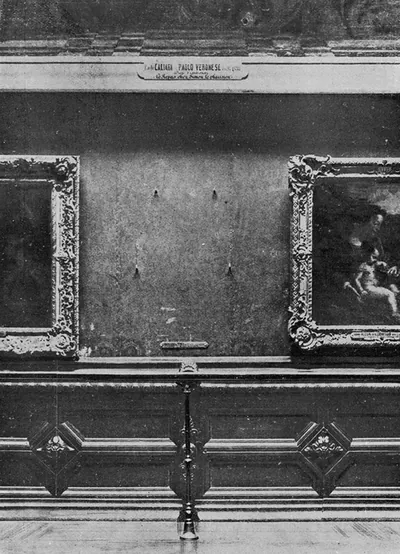
A closed museum and a white smock
On Monday 21 August 1911 the Louvre was closed to visitors. Vincenzo Peruggia and two other Italian handymen, the brothers Vincenzo and Michele Lancelotti, had hidden overnight in a narrow storeroom near the Salon Carré. In the morning, in white workmen’s smocks, they lifted a small painting off the wall, stripped off its glass box and frame, and Peruggia hid it under his clothes. Smithsonian
HISTORY’s account adds a comic detail: a stairwell door was locked, and a Louvre plumber who came by took the thief for a stuck colleague and helped him open it. HISTORY
Peruggia knew the painting well. He had worked for the glazing firm Cobier, which spent three months putting a dozen of the Louvre’s most prized paintings under glass after a threat to the Mona Lisa in 1910. Smithsonian
Picasso in the frame
The Louvre was huge and lightly guarded: more than 1,000 rooms, and fewer than 150 guards for about a quarter of a million objects. Smithsonian When the police did investigate, they questioned Peruggia, believed his story that he had overslept, and instead arrested the artist Pablo Picasso and the poet Guillaume Apollinaire. Both were soon released. Smithsonian
When the museum reopened, crowds came to stare at the empty wall. Among them was the writer Franz Kafka. Smithsonian
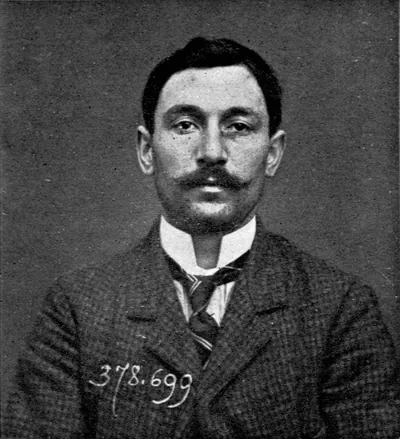
Twenty-eight months in a trunk
Peruggia kept the painting in the false bottom of a wooden trunk in his Paris lodgings. Smithsonian In December 1913, after 28 months, he took it by train to Florence and offered it to an art dealer, who called the police. Smithsonian HISTORY names the dealer as Alfredo Geri, who brought in Giovanni Poggi, director of the Uffizi, and says Peruggia was arrested at his hotel on 11 December 1913. HISTORY
At his trial Peruggia said national pride made him do it, believing the painting had been looted from Italy under Napoleon. HISTORY points out that he was wrong: Leonardo had taken the Mona Lisa to France himself in 1516. HISTORY
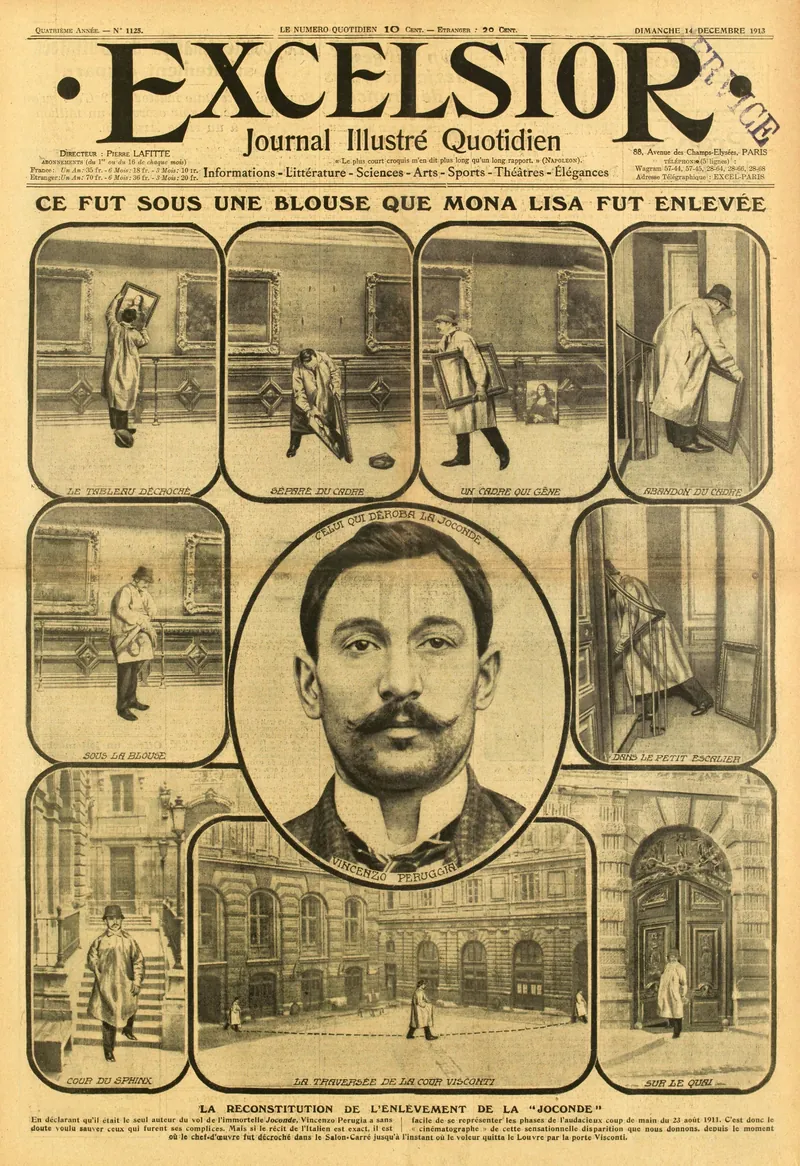
The theft that made a superstar
Before 1911 the Mona Lisa was admired but not a global icon: Baedeker’s 1907 guide to Paris gave it just two sentences. Smithsonian After the theft it was everywhere: postcards, cabaret songs, a short film. In the first two days after it was rehung in the Salon Carré, more than 100,000 people came to see it. Smithsonian